
- Academics
- Admissions
- Enrollment & Registration
- Research
- Academic & Creative Spaces
- Strategic Partnerships
- Our Impact
- Student Affairs
- Alumni
- About VCUarts Qatar
- Community & Continuing Education
ADMISSIONS FOR FALL 2027 NOW OPEN + NEW MERIT SCHOLARSHIP AVAILABLE


Secrecy is Immoral
Oct. 27 – Dec. 3, 2026
Exhibition on View
Nov. 4, 6:30-8 p.m.
Opening Reception
About the Exhibition
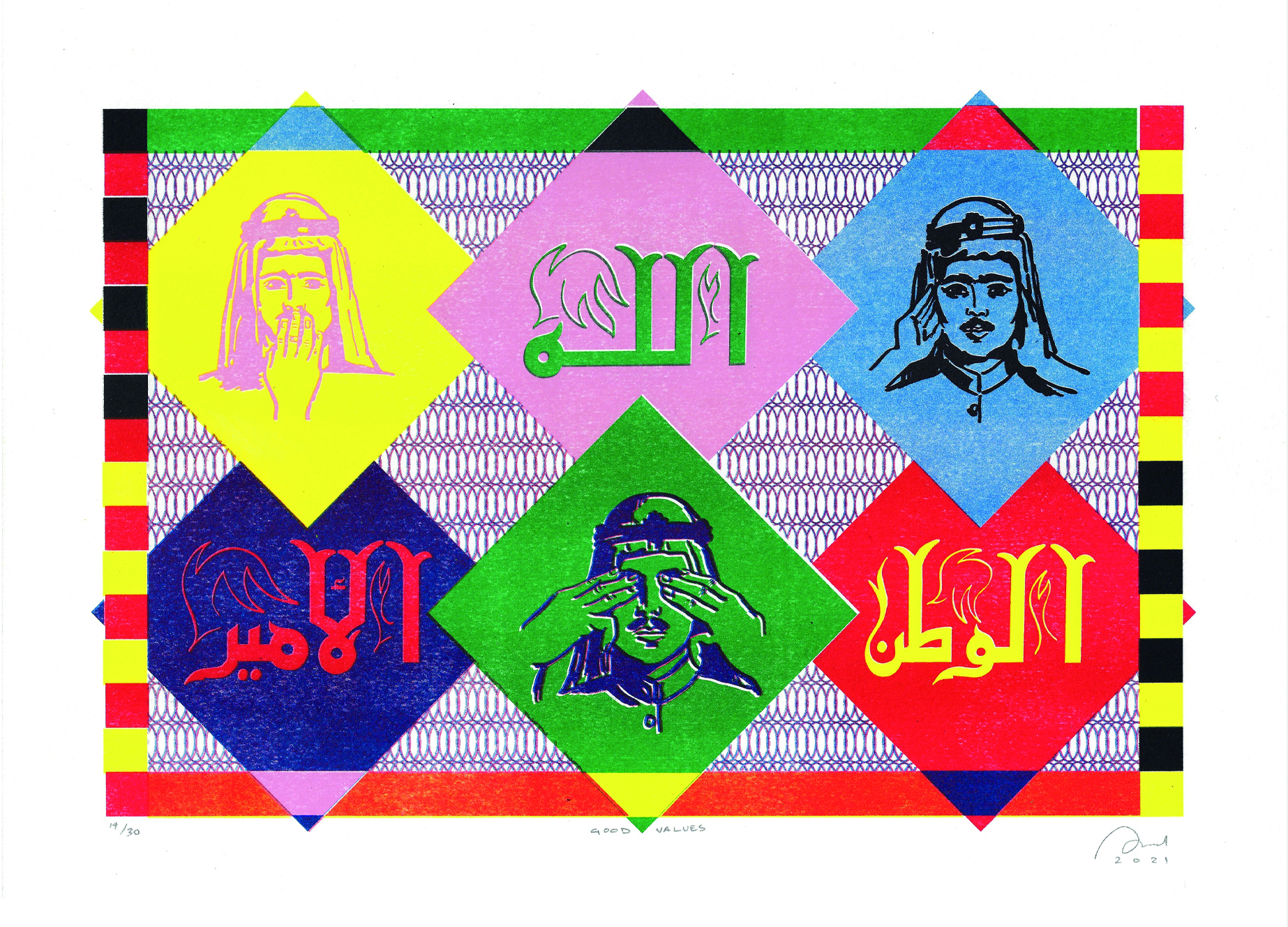
The Gallery at VCUarts Qatar is pleased to present Secrecy is Immoral, a group exhibition organized in partnership with Tasmeem Doha 2026: Transmit حول. The exhibition brings together works by Aseel AlYaqoub, Amad Ansari, Lennart Lahuis, Kameelah Janan Rasheed, and Slavs and Tatars.
“The fruits of science are for the whole of humanity, and knowledge and wisdom cannot be bartered or sold; secrecy is immoral.¹”
The unity of knowledge and ethics is a defining principle within Islam. Knowledge is viewed as a trust (amanah) meant to benefit all, where its pursuit, preservation, and transmission contribute to the community’s public good. Historically, this ethical grounding ensured that learning could not be monopolized, resisting its enclosure within systems of power or profit2. By contrast, modern capitalist structures often turn knowledge into patented property, severed from shared responsibility.
Secrecy is Immoral is a group exhibition that approaches knowledge as a living, evolving process. The works explore multiple modes of transmission: interrogating historical narratives and inherited power structures; archiving and preserving traces of resistance, advocacy, and cultural memory; and experimenting with non-linear forms of dispersion. Together, they affirm that the value of knowledge lies not in its control, but in its circulation.
¹ Ziauddin Sardar, How Do You Know: Reading Ziauddin Sardar on Islam, Science and Cultural Relations, 147.
2 Moin on Hallaq, ‘Restating Orientalism: A Critique of Modern Knowledge’ | H-Net.
Artwork





Artist Bios
Amad Ansari is a technologist and artist who seeks to excavate culture, knowledge, and aesthetics across the history of the Internet and create user experiences which reconfigure and honor them in a new light. In his practice he aims to bridge the gap between the world accumulated within the screen and the physical world we live in. His work has been featured in exhibitions at SculptureCenter, CultureHub, Museum of the Moving Image, and Pioneer Works in New York City, and Bayt Al Mamzar in Dubai.
Aseel AlYaqoub is a research-based artist and writer from Kuwait. Her interdisciplinary practice explores how memory and identity are constructed through built environments, material culture, and archival systems. She has exhibited internationally at Desert X AlUla, the Venice Architecture Biennale, and Bildmuseet. Her work is featured in publications including Deserts Are Not Empty and Iridescent Kuwait.
Kameelah Janan Rasheed is a learner and a death doula in training. Her middle name, Janan, meaning heart and soul, comes from the Arabic trilateral root (J-N-N / جنان) evoking that which is unmoored, veiled, and wayward. Accordingly, she explores the politics and poetics of non-compliance and disobedience across written, spoken, and visual language. A “language person” (Paul Soulellis), she “gives language a body” (Chang Yuchen) through her large-scale installations, multichannel video works, publications, software, performance, public archives, and learning platforms.
She has received awards, including a Guggenheim Fellowship (2021) and a Creative Capital Award (2022), and has had exhibitions worldwide. Rasheed is a full-time critic at Yale University’s School of Art and the inaugural Charles Gaines Chair at CalArts. Through KJR Studios, she founded The Little Octopus School and Orange Tangent Study, initiatives centered on collaborative learning and institutional experimentation.
Lennart Lahuis received his BFA from ArtEZ University of the Arts (NL), from 2011 to 2013 he took part in the postgraduate program De Ateliers in Amsterdam (NL). His work subjects visual information to natural processes such as evaporation and erosion. He juxtaposes natural phenomena with technical systems and scientific methodologies. The precision of science and technology is set against the volatility and unpredictability of natural phenomena. Departing from transience and entropy, Lahuis’ objects and installations explore the limits of intelligibility and the material conditions of readability.
Slavs and Tatars is an international art collective focused on Eurasia, between the former Berlin Wall and the Great Wall of China. Founded in 2006, it explores political and cultural debates through hybrid knowledge drawing on popular culture, spiritual traditions, oral histories, myths, and research. Its practice includes exhibitions, publications, and lecture-performances, with global exhibitions and numerous books. The collective also runs Pickle Bar and regional residency programs, and engages audiences through interdisciplinary artistic methods.