
- Academics
- Admissions
- Enrollment & Registration
- Research
- Academic & Creative Spaces
- Strategic Partnerships
- Our Impact
- Student Affairs
- Alumni
- About VCUarts Qatar
- Community & Continuing Education


Matter Diplopia at Design Doha Biennial 2026
Matter Diplopia explores materiality, cultural constructs, and societal impact in Qatar. Through the concept of dual vision—seeing and understanding the material world through multiple lenses—this exhibition considers the interplay of local and global contexts and tangible and intangible cultural narratives, revealing the intricate connections that shape the material world.
The relationship between materiality and culture is a continuous, reciprocal cycle, and as a place of rapid and evolving development, Qatar is a unique site to investigate this duality. Matter Diplopia features a diverse array of experimental and exploratory practice-based inquiries, integrating traditional modes of making with emergent technologies.
Each project is a collaborative efforts among faculty, students, and alumni at VCUarts Qatar, embracing diverse perspectives and disciplinary domains. In keeping with the theme of dual vision, the exhibition juxtaposes explorations of Qatar’s natural and built environment with projects rooted in cultural heritage and preservation.
Central to Matter Diplopia are the themes of fluidity, transference, and material agency. The exhibition presents works that embody the continuous exchange between local conditions and global influences, demonstrating how materials can transcend their origins and offer unique perspectives on complex issues. Matter Diplopia invites viewers to consider multiple lenses to critically consider the interconnectedness between environment, culture, and technology.
Dates: November 5, 2026–January 31, 2027
Daily timings: 9 a.m.–9 p.m.
Location: Fereej Al Asmakh
Projects
DUB DOUBT

DUB DOUBT is inspired by the sound-system, a pyramid of speakers invented by Jamaican DJs in the 1960’s. In this installation vibrating sculptures replace the speakers. These sculptures, with the features of a dub icon, are reproduced by artists from Egypt, Qatar, and Italy. From one side, peer at them through filters inspired by Arabian ‘mashrabiyas’ or privacy screens. Move to the other to touch the sculptures and feel the vibrations set off by the separate tracks of a tune.
The use of different materials results in distinct vibrations or ‘surface reflections.’ Diverse artists, cultures, and trajectories challenge the doubt of appropriation, dubbing positive vibrations.
Team members:
- Simone Carena
- Marco Bruno
- Sherin Karawia
- Alaa Albarazy
Dunes and Dugongs
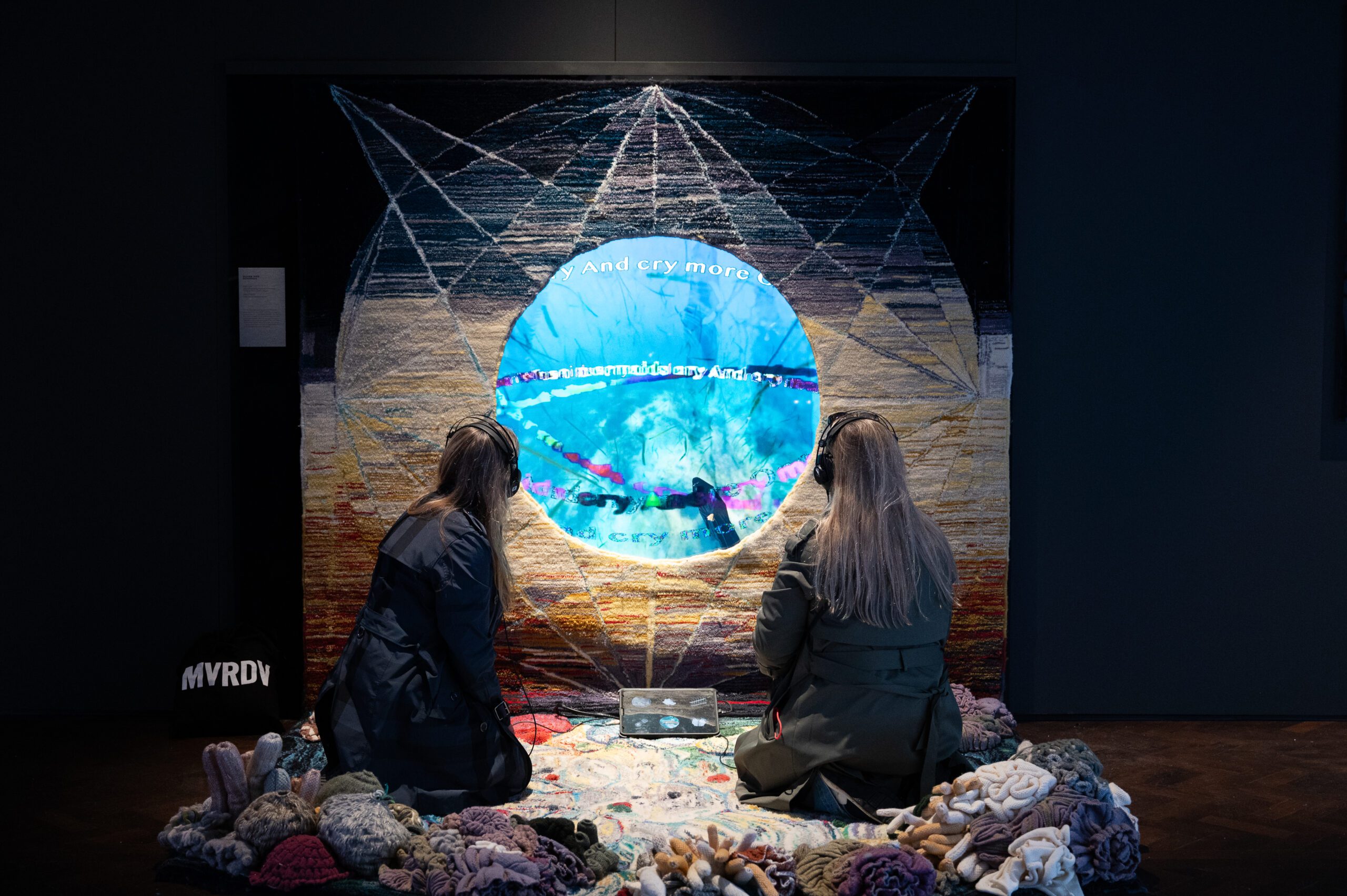
Dunes and Dugongs brings together textiles, sculpture, sound, poetry, and moving image, drawing connections between Qatar’s desert and sea as interconnected spaces of habitation, sustenance, protection, and refuge.
The installation approaches the global concern of climate change through the relationship between human agency and environmental stewardship. Rather than presenting ecological crises as a distant or abstract phenomenon, the work invites viewers to consider how individual and collective actions shape the environments we inhabit. The land and sea sustain human life by providing food, resources, shelter, and protection; in turn, these environments require care, conservation, and rehabilitation.
Through a poetic narrative, Dunes and Dugongs position the viewer not simply as an observer, but as a participant within a larger ecological system. The installation asks how we understand our reciprocal relationship with the environments that sustain us, and what forms of responsibility emerge from recognizing that the places that protect and sustain us must, in turn, be protected.
Team members:
- Charlotte Rodenberg
- Joshua Rodenberg
- Neihan Yaqoob
- Esther de Veuve
Studio Assistants:
- Fariha Ahmed
- Felicity Ulmer
- Polie Campiteli
- Maria Luz Romeo
Consultant:
- Michael Wirtz
Community Partner:
- Liwan Design Labs and Studio
Discursive Instrumentation of Urban Rhythms

Qatar’s urban spaces represent a cultural terrain made up of movement and migration. This terrain embraces modernity and technology, accommodating diverse cultural diasporas. Discursive Instrumentation brings this cultural environment to life by reproducing the soundscape of Doha. The project is an ensemble of three instruments, each representing a key feature of the urban environment: The Body, The City, and The Worker. The Body represents infrastructure. The Worker represents the individual. The City represents movement.
A visitor interacting with each part of the installation comes across the familiar and unfamiliar. When the three are played together, the resulting soundscape creates something completely new.
Team members:
- Shankar Padmanabhan
- Dana EL Ladki
- Hagar Allam
- Hira Nisar
Greener Greenhouse Goes GMT

With eyes for London but erected in Kenya, Greener Greenhouse goes GMT is a space that grows from its place. The bamboo for the structure grew mere meters away. Informed by the Victorian glasshouse, Greener Greenhouse goes GMT is a modest echo of Joseph Paxton’s 19th century Crystal Palace. The structural principle of the project builds on experiments with bamboo greenhouses from the perspective of the Global South. Unique friction joinery embodies Kenya’s social material context of:
- second hand market for rubber;
- resourceful metal workers; and
- bamboo in abundance
The project is a Crystal Palace reverberating back from the Global South – an echo slightly changed.
Team members:
- Dr. Johan Granberg
- Dr. Byradley Yyelland
- Rebecca Wasikye
- Lolwa Al-Thani
- Nour Mahmoud
- Khulood Almaskar
- Ayah Abdelwahab
- Rand Assad
- Ayah ElFihal
- Israa Mahjoub
Stone Plus

Stone Plus explores the potential of a unique sedimentary stone sourced from the Al Khor area in Qatar. Slabs of this material were originally intended for the cladding of buildings in the Msheireb regeneration project in downtown Doha. However, due to inherent impurities and structural fragility, they could not be utilized.
Our research focused on finding ways to repurpose the slabs and we developed four strategies to strengthen the material and turn its imperfections into meaningful design features. The result is a collection of coffee tables where metal braces, stone buttresses, epoxy resin grooves and polyester ratchet straps are used to reinforce the slabs with the goal of generating a new collaborative material aesthetic.
Team members:
- Marco Bruno
- Levi Hammett
- Simone Carena
- Mohammad Suleiman
- Dr. Haithem El-Hammali
Industry Partner:
- Erika Pisu (Akire Stone Design)