
- Academics
- Admissions
- Enrollment & Registration
- Research
- Academic & Creative Spaces
- Strategic Partnerships
- Our Impact
- Student Affairs
- Alumni
- About VCUarts Qatar
- Community & Continuing Education
VCUarts Qatar will be at Ars Electronica 2026 (Sept. 9-13)

Sustainable Cardboard Furniture for Children (ages 14 -17)
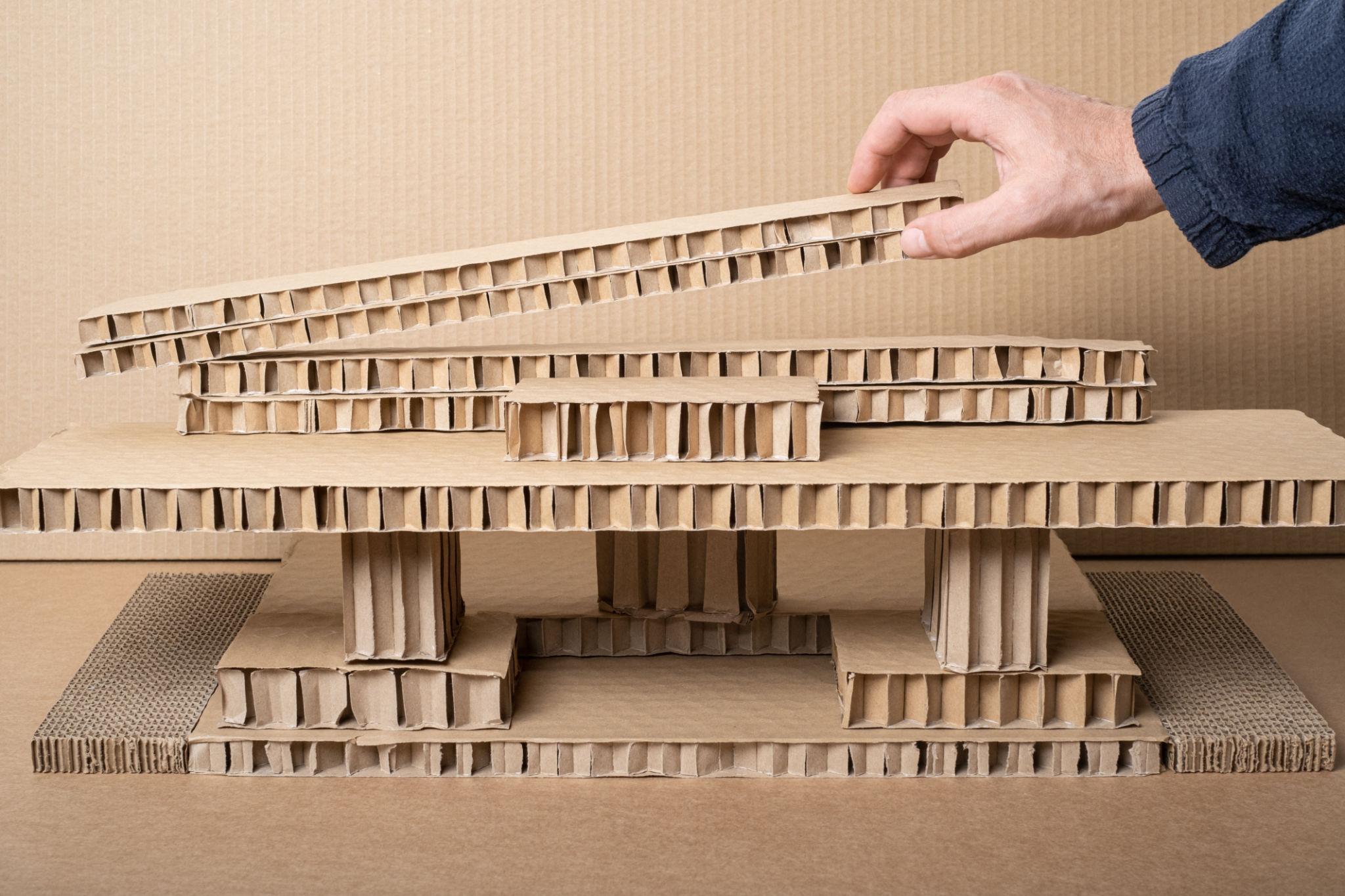
About This Class
This hands-on course introduces participants to the fundamentals of sustainable design, engineering, and fabrication through the challenge of creating a functional cardboard chair. Students will explore eco-friendly materials and processes while learning how to design with purpose, balancing aesthetics, structure, and usability. Through guided modules, they will develop their ideas from initial sketches to detailed orthographic drawings, applying key engineering principles such as load distribution, stability, and reinforcement.
Throughout the course, participants build strong technical and creative skills, including precision measuring, cutting, prototyping, and translating 2D designs into 3D objects. They will experiment with material behavior, test structural strength, and refine their designs through iteration. Emphasis is also placed on ergonomic thinking and sustainability, encouraging students to make responsible design decisions, minimize waste, and understand the life cycle of materials.
By the end of the program, participants will have constructed a fully functional cardboard chair using only assembly techniques and non-toxic materials, capable of safely supporting weight. They will also gain valuable soft skills such as problem-solving, collaboration, and effective communication, presenting their final designs and reflecting on their process. Rooted in STEAM learning, this course integrates science, technology, engineering, art, and mathematics into an engaging and practical design experience.
Learning Outcomes
By the end of this course, students will be able to:
- Design a functional piece of furniture using sustainable materials and eco-friendly processes.
- Produce accurate orthographic drawings (front, top, side views) with dimensions and annotations.
- Apply engineering principles such as load distribution, stability, and reinforcement.
- Construct a cardboard chair using assembly techniques only, without mechanical fasteners.
- Evaluate and test structural strength to safely support a minimum load of 60 kg.
- Incorporate ergonomic principles to ensure comfort, safety, and usability.
- Demonstrate responsible material use and reflect on sustainability in product design.
- Communicate design intent and construction processes clearly through presentations and documentation.
Skills Developed
Technical & Engineering Skills
- Structural analysis (compression, bending, load paths)
- Material behavior and reinforcement techniques
- Precision measuring, cutting, and assembly
- Prototyping and physical testing
- Ergonomic design fundamentals
Design & Visualization Skills
- Orthographic technical drawing
- Sketching and concept development
- Translating 2D drawings into 3D objects
- Iterative design improvement
Sustainability Skills
- Sustainable material selection
- Waste minimization and material optimization
- Understanding life-cycle thinking
- Responsible use of non-toxic materials
Soft Skills
- Problem-solving and critical thinking
- Time management and planning
- Collaboration and peer feedback
- Presentation and reflection skills
Course Structure & Key Milestones
Module 1: Introduction to Sustainable Design
- Sustainability and eco-friendly materials
- Case studies of cardboard furniture
- Safety guidelines and project constraints
Module 2: Design & Technical Drawing
- Furniture function and ergonomics
- Chair anatomy and dimensions
- Creating 3 orthographic views
- Design review and feedback
Module 3: Engineering & Material Testing
- Load-bearing principles
- Cardboard strength and layering techniques
- Joint and assembly strategies
- Small-scale testing
Module 4: Fabrication & Assembly
- Cutting techniques and accuracy
- Assembly using water-based glue
- Structural reinforcement without fasteners
- Quality control and finishing
Module 5: Testing & Evaluation
- Stability and safety testing
- Load test up to 60 kg
- Ergonomic assessment
- Design iteration if needed
Module 6: Presentation & Reflection
- Final product presentation
- Design explanation and justification
- Sustainability reflection
- Peer and instructor feedback
Curriculum Alignment (STEAM)
- Science: Material properties, forces, sustainability
- Technology: Tools, fabrication methods
- Engineering: Structural systems, testing, optimization
- Art & Design: Form, aesthetics, ergonomics
- Mathematics: Measurement, proportions, load estimation
Materials and Equipment Needed
Please note that VCUarts Qatar reserves the right to cancel the course if the minimum number of participants is not met. In such cases, all paid fees will be fully refunded.
Participants are encouraged to purchase their own materials in advance and bring them to each session. A limited selection of essential materials and equipment will be available during class; however, participants are responsible for ensuring they have what they need to complete their projects.
A detailed list of required materials will be shared during the first session, along with guidance from the instructor.
Safety & Sustainability Guidelines (Materials & Workshop Use)
All load testing must be carried out under proper supervision. For questions about material please email [email protected]
- Use only non-toxic, water-based adhesives at all times.
- Metal, plastic, or mechanical fasteners are not permitted.
- Ensure all cardboard edges are properly finished to prevent injury.
- Minimize material waste and recycle all excess cardboard whenever possible.
Schedule
Start: Sun Sep 6, 2026
End: Thurs Oct 1, 2026
Lessons: 8
Days: Sundays and Thursdays
Time: 5:30-7:30 PM
Location: VCUarts Qatar Campus
Cost: 850 QAR
Instructor

Oumnya Lemoudda
Oumnya is an accomplished educator and STEAM specialist with extensive international experience in designing and delivering innovative, student-centered learning programs. With a strong academic foundation, including a Ph.D. in Material Science from the Technical University of Dresden, she brings deep technical expertise combined with a passion for education. Oumnya has successfully developed and implemented interdisciplinary STEAM curricula that equip students with both technical competencies and essential soft skills through creative, project-based learning approaches.
Throughout her career, Oumnya has held leadership roles in prestigious educational institutions across the Middle East and Europe, including serving as Teacher Coordinator for Engineering and STEAM at Michael E. DeBakey High School in Qatar. She has led curriculum design, teacher training, and program development initiatives, integrating modern teaching methodologies such as flipped classrooms and experiential learning. Her work extends beyond the classroom through mentoring student clubs, coordinating internships, and guiding students to success in national and international competitions.
Fluent in English, French, Arabic, and German, Oumnya brings a truly global perspective shaped by her experience living and working across multiple countries. She is committed to advancing education through innovation, sustainability, and interdisciplinary collaboration, empowering students to become critical thinkers, problem solvers, and responsible global citizens.