
- Academics
- Admissions
- Enrollment & Registration
- Research
- Academic & Creative Spaces
- Strategic Partnerships
- Our Impact
- Student Affairs
- Alumni
- About VCUarts Qatar
- Community & Continuing Education
NOTICE:
Amid the ongoing regional situation the university has moved to remote operations and public access to its premises are not available. Information on scheduled activities will be communicated to individuals directly.

When Design Meets Neuroscience: Multiversity Research Explores Lighting’s Impact on Autism
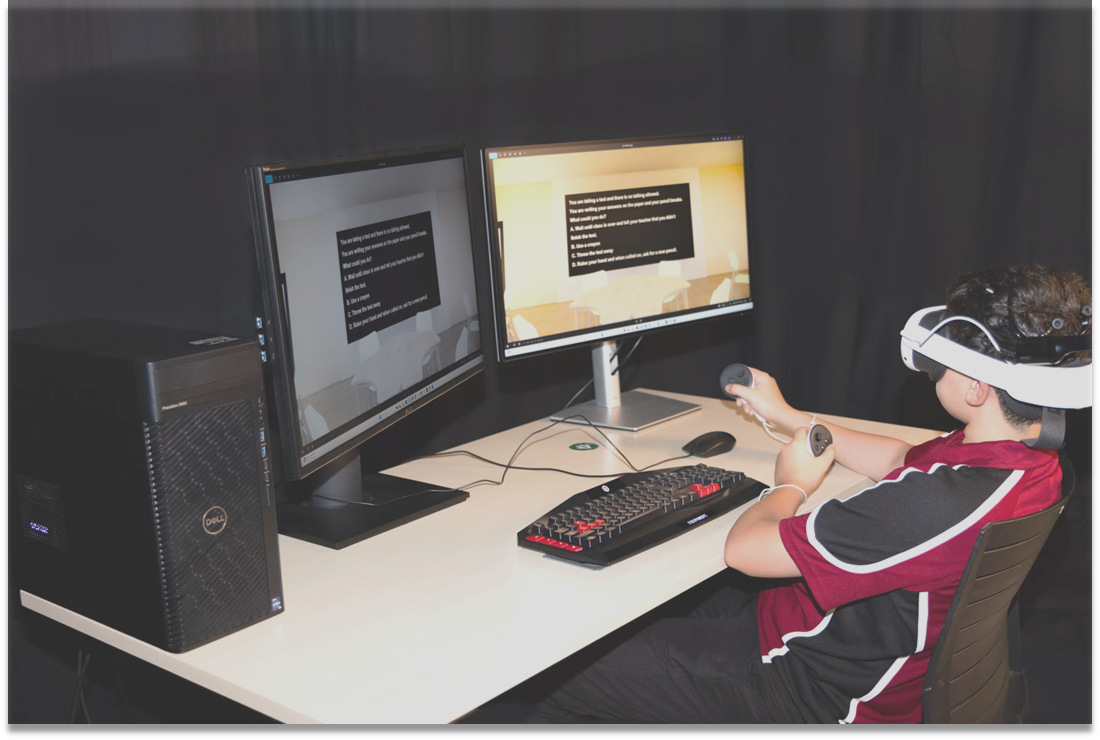
Findings reveal how different lighting conditions trigger distinct brain responses, offering new insights for inclusive learning and healthcare environments
Virginia Commonwealth School of the Arts Qatar (VCUarts Qatar) is redefining the role of art and design in scientific discovery, leading research with Weill Cornell Medicine–Qatar (WCM-Q) that uses neuroimaging and virtual reality to explore the impact of different environments on autistic learners.
“Our work sits at the intersection of design, neuroscience, and behavioral science,” explained Dr. Cherif Amor, Associate Dean for Academic Affairs at VCUarts Qatar and the study’s principal investigator. “For decades, decisions in architecture and interior design have been based on perception and preference – how people say they feel in a space. With this research, we are going deeper to understand what is actually happening in the brain while individuals experience an environment.”
The study builds on the foundation of design and behavioral science research that has already shown that neurodiverse learners are particularly sensitive to interior environmental conditions like light, color, sound, and proxemics.
“By measuring cognitive activity in real-time and in response to different lighting spectrums, we can begin to develop evidence-based design strategies that move beyond subjective feedback. What we learned about how design triggers certain brain activity will inform how we create environments, classrooms, in this case, that genuinely support learning and wellbeing,” Dr. Amor said.
The research is backed by the VCU Quest Fund, an internal grant program that gives faculty the opportunity to transform creative inquiry into solutions that advance various sectors, including health, education, and society.
It benefited from a cross-disciplinary collaboration between VCUarts Qatar, WCM-Q, and Virginia Commonwealth University in Richmond, Virginia. Staci Carr, PhD, an expert in Developmental and Cognitive Psychology at the VCU Center on Transition Innovations, contributed her knowledge in Functional Behavioral Assessment and Learning Disabilities. Haithem A. El-Hammali, PhD, an Assistant Professor of Interior Design at VCUarts Qatar, brought his expertise in Virtual Reality and Building Information Modeling to the project. Additionally, Dr. Ryad Ghanam and Dr. Ed Boone, both professors of Mathematics respectively at VCUQ and VCU, provided critical support in statistical and psychometric data analysis, grounding the research in strong quantitative methods.
The study itself investigated how fluorescent lighting’s Correlated Color Temperature (CCT) – warm white, cool white, daylight, and achromatic (no hue) – affects cognitive and behavioral responses in autistic individuals.
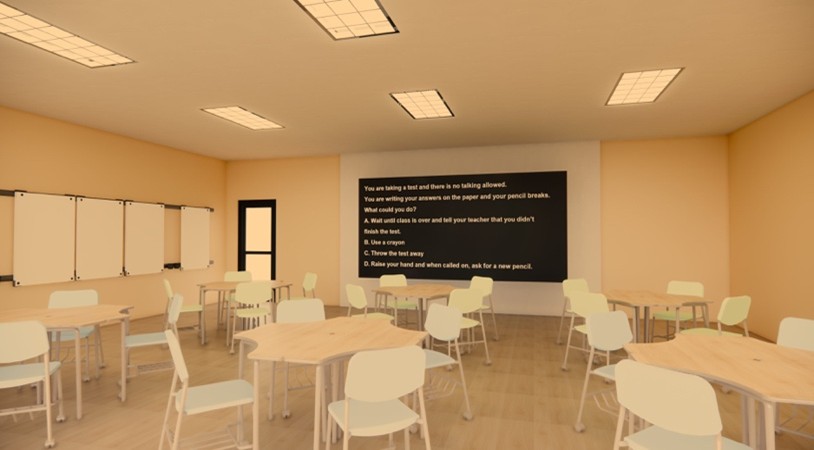
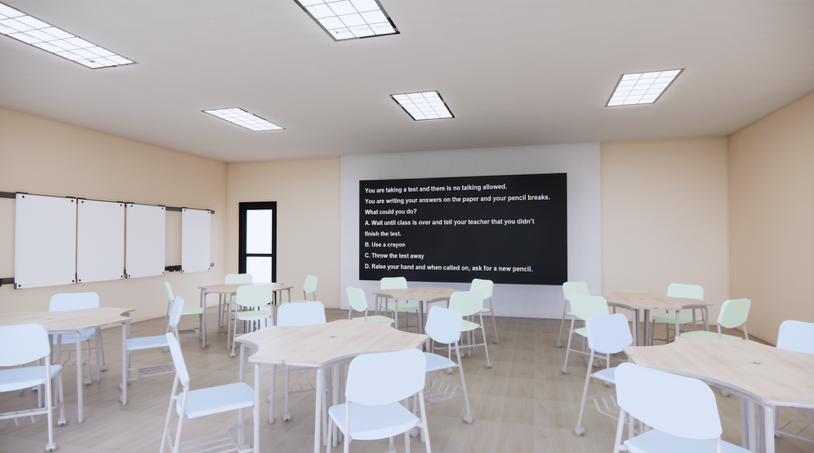
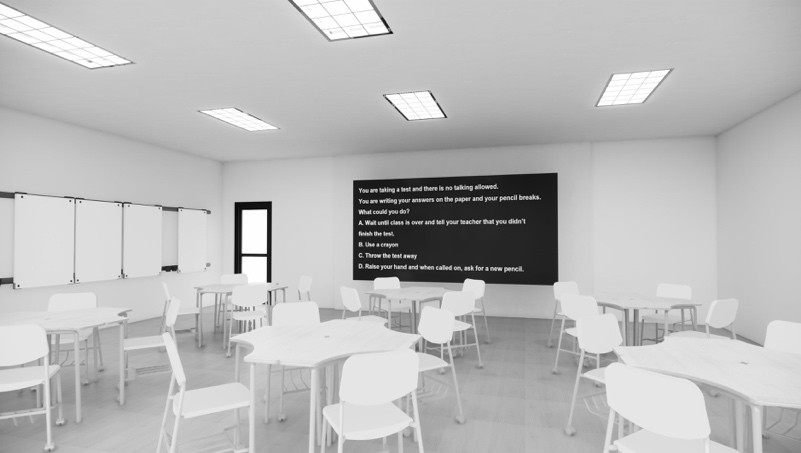
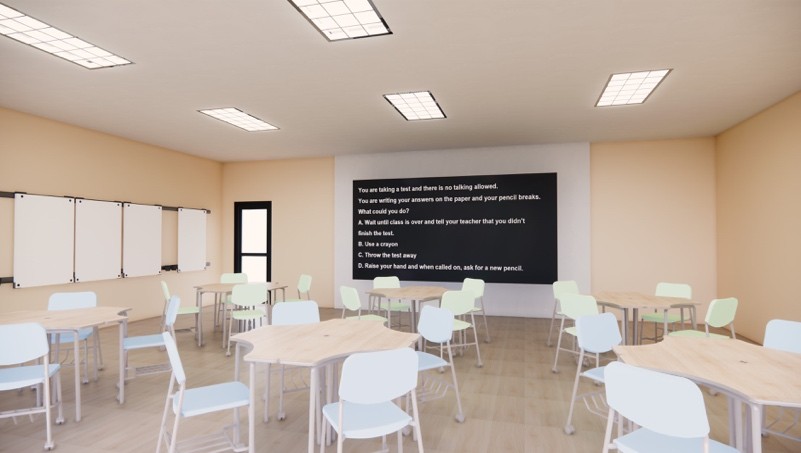
Autistic participants carried out tasks in immersive VR classrooms set under different lighting conditions, while their brain activity was monitored using an EEG headset. The tasks ranged from math-based problems to test logical and analytical processing; reading passages and answering questions to measure focus, retention, and understanding; and problem-solving tasks that required decision-making and sustained attention.
Results showed that cool white lighting enhanced prefrontal cortex activity, linked to attention and executive functioning. Daylight and warm white color temperatures showed less activity in the prefrontal cortex and actually induced stress, which could in turn inhibit cognitive processing in autistic individuals. influenced synchronized visual-cognitive processing across brain regions.
Dr. Ghizlane Bendriss, Assistant Professor of Biology at Weill Cornell Medicine-Qatar and co-principal investigator of the study explained that because autism is a spectrum disorder, a wide range of responses to light intensity and color temperature is expected. However, she emphasized that: “The use of EEG was particularly valuable, as it provided a direct, objective measure of how sensory stimulation affected neural processing.
“EEG in sensory studies generates a vast amount of complex data influenced by multiple confounding variables, and the use of advanced AI and statistical approaches represents a major advantage that can help move this field forward.”
Ultimately these results highlighted what researchers at VCUarts Qatar have long believed: that design choices are not just superficial, they have the power to influence how people feel, think, and function. It provides the foundational data that can guide architects, designers, and healthcare professionals in creating supportive built environments.
“Our next step is to expand this paradigm by comparing the results of neurodiverse and neurotypical participants and testing additional environmental variables, not just lighting,” said Dr. Amor. “With advances in neurotechnology, we can build a stronger scientific foundation for design decisions to develop evidence-based guidelines that inform architecture, interior design, and lighting sources and fixtures manufacturers.”
The study was recently presented at the Academy of Neuroscience for Architecture’s 20th Anniversary Conference (ANFA 2025), and the World Congress on Health and Design (WCDH 2025), leading global venues where architecture and neuroscience intersect. It builds on earlier work that Dr. Amor and his collaborators shared at the Medical Humanities in the Middle East Conference in Doha in 2018, which was later published in Innovations in Global Health Professions Education (2019). Related strands of this research have also been featured in the Health Environments Research & Design Journal.
“Arts and design-centered research has always had the power to drive meaningful change across sectors,” said Dr. Diane Derr, Associate Dean for Research and Development. “This project, showcased internationally and most recently during VCUarts Qatar Week 2025 alongside other groundbreaking initiatives from our Qatar faculty, highlights our commitment to research that delivers real-world impact.”