
- Academics
- Admissions
- Enrollment & Registration
- Research
- Academic & Creative Spaces
- Strategic Partnerships
- Our Impact
- Student Affairs
- Alumni
- About VCUarts Qatar
- Community & Continuing Education
VCUarts Qatar will be at Ars Electronica 2026 (Sept. 9-13)

Portfolio Development Class E (Online)
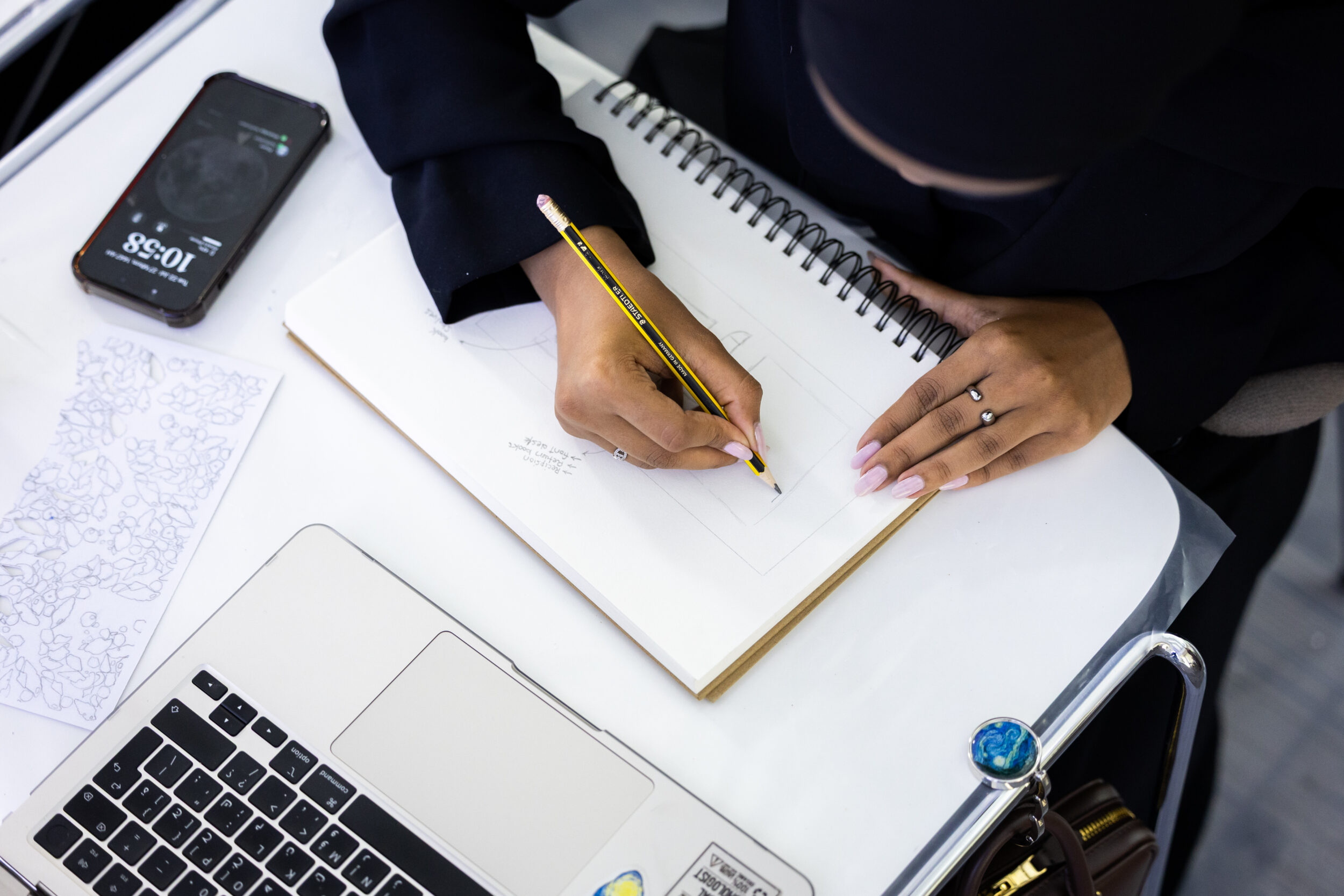
About this class
The admissions portfolio requirements for VCUarts Qatar emphasize creative thinking, experimentation, and the development of ideas as being equally important as technical and drawing skills.
This fully online Portfolio Development course is designed to help participants develop a strong and competitive art and design portfolio from wherever they are in the world. Through live demonstrations, creative exercises, independent studio work, group discussions, and personalized feedback, participants will learn how to generate ideas, experiment with different approaches, document their creative process, and present their work effectively.
Participants will work with both traditional and digital media, using materials that are easily accessible at home. Throughout the course, they will maintain a digital and/or physical sketchbook and gradually develop a collection of work that demonstrates experimentation, observation, creative thinking, and personal interests.
The course will also introduce participants to what an art and design education involves and help them better understand how to communicate their creative process through a portfolio.
Because the course is online, participants will regularly photograph, scan, upload, and present their work digitally. This will give them practical experience in preparing artwork for an online portfolio submission.
Please note: This is an intensive, hands-on portfolio development program. Each session combines presentations, demonstrations, conceptual exercises, technical development, studio work, group discussions, critiques, and individual feedback. Participants are expected to continue developing their work independently between sessions.
The course is structured to help participants create a substantial body of portfolio work within a short period of time, while allowing sufficient time toward the end of the program to refine, strengthen, and polish their strongest pieces.
Projects and assignments will be adapted according to each participant’s interests, existing skills, preferred media, and intended area of study.
Online Class Format
Classes will be delivered live online and will combine:
- Live instructor demonstrations and presentations
- Individual and group creative exercises
- Independent studio-making time
- Digital and traditional sketchbook development
- Breakout-room discussions and peer critiques
- Screen sharing and digital portfolio reviews
- One-on-one feedback from the instructor
- Independent assignments between sessions
- Photography and digital documentation of artwork
- Final individual portfolio review and recommendations
Participants should have access to a computer or tablet with a camera and microphone, as well as a smartphone or camera for photographing their artwork.
Class Outline
Class 1: Creative Direction, Ideas & Portfolio Building
The first class establishes the foundation for the entire portfolio.
Participants will be introduced to what makes a strong art and design portfolio, with particular emphasis on creative thinking, experimentation, personal interests, idea development, and process.
Through a presentation and guided exercises, participants will identify their individual interests, influences, subjects, and areas of curiosity. They will also review any existing artwork or portfolio materials and begin identifying strengths, weaknesses, and areas that need further development.
Participants will be introduced to the idea of developing a body of work rather than a collection of unrelated artworks.
In-class work:
- Creative thinking and idea-generation exercises
- Personal interest and visual research exercises
- Sketchbook development
- Initial concept development
- Visual brainstorming and mind mapping
- Introduction to experimentation and iterative thinking
- Individual discussions about each participant’s interests and portfolio goals
- One-on-one feedback
Assignment:
Participants will develop several initial ideas and visual studies independently and bring their experiments to the following class.
Goal: Establish each participant’s creative direction and generate multiple potential portfolio projects.
Class 2: Experimentation, Materials & Finding Your Visual Language
This class focuses on making and experimentation.
Participants will explore how materials, techniques, composition, color, texture, scale, layering, repetition, and process can be used to communicate an idea.
The instructor will demonstrate a range of approaches using accessible materials, while participants experiment and begin developing their own visual language.
Rather than producing one predetermined class project, participants will use the exercises to begin developing work connected to their own interests.
In-class work:
- Material and media experimentation
- Drawing and mark-making
- Color and composition studies
- Mixed-media experimentation
- Scale and format exploration
- Combining unexpected materials
- Developing visual references
- Individual experimentation based on personal interests
- Group discussions and critiques
- One-on-one technical and conceptual feedback
Assignment:
Participants will select their strongest experiments and develop them into more focused studies or project ideas outside of class.
Goal: Move from experimentation toward a clearer personal direction and identify media and techniques that can support each participant’s ideas.
Class 3: Concept Development & Research
This class focuses on taking an initial interest and turning it into a developed creative concept.
Participants will learn how artists and designers use research, observation, references, experimentation, and questioning to develop ideas.
The presentation will introduce:
- Concept development
- Visual research
- Artist and designer references
- Context and subject matter
- Observation and interpretation
- Asking meaningful questions
- Connecting research to making
- Developing a project through multiple stages
Participants will then apply these ideas directly to their own projects.
In-class work:
- Research exercises
- Image and reference gathering
- Concept mapping
- Sketchbook development
- Preliminary studies
- Compositional experiments
- Individual project development
- Group critiques
- One-on-one conceptual feedback
Assignment:
Participants will continue developing their selected project independently and produce a more developed body of studies, sketches, experiments, or preliminary work.
Goal: Transform an initial idea into a project with depth, direction, and potential for further development.
Class 4: Technical Development & Making
This class moves deeper into technical skill development and production.
The technical content will be adapted to participants’ preferred media and portfolio directions.
Demonstrations may include drawing, painting, printmaking, collage, photography, digital processes, sculpture, mixed media, illustration, or other relevant approaches.
The emphasis is on understanding how technical decisions can strengthen conceptual ideas.
In-class work:
- Technical demonstrations
- Guided exercises
- Medium-specific experimentation
- Developing compositions
- Working from observation and/or reference
- Testing techniques
- Troubleshooting technical challenges
- Beginning or advancing major portfolio pieces
- Individual technical guidance
- One-on-one studio feedback
Assignment:
Participants will continue producing their major portfolio work outside of class.
They are expected to bring substantial progress to the next session.
Goal: Develop the technical confidence necessary to turn concepts into resolved portfolio work.
Class 5: Observational Drawing & Line
- Introduction to observational drawing with an emphasis on seeing rather than simply copying.
- Participants will explore contour drawing, line quality, proportion, positive and negative space, and composition.
- Objects available within the participant’s own environment will become drawing subjects.
- Online activity: Guided live observational drawing exercises followed by individual feedback.
Class 5: Developing Stronger & More Ambitious Work
At this stage, participants should have multiple ideas and works in progress.
This class focuses on pushing the work further rather than accepting the first successful result.
Participants will learn how to recognize when an idea needs further development and how experimentation can lead to stronger outcomes.
Topics include:
- Iteration
- Variation
- Risk-taking
- Refinement
- Scale
- Composition
- Material decisions
- Combining techniques
- Developing a series
- Responding to unexpected outcomes
- Moving beyond the obvious solution
In-class work:
Participants will spend significant time actively making and developing their work.
The instructor will move between participants to provide individual feedback and guidance while also facilitating group discussions and critiques.
Assignment:
Participants will continue developing their strongest projects and begin identifying which works have the potential to become key pieces within their final portfolio.
Goal: Push the work beyond basic exercises and toward strong, personal, portfolio-level pieces.
Class 6: Building a Cohesive Body of Work
By this stage, participants should have accumulated a significant amount of material.
This class focuses on editing, connecting, and expanding the work so that the portfolio begins to function as a cohesive body of work.
Participants will review their projects and consider:
- What ideas are emerging?
- What subjects or themes connect the work?
- Which pieces are strongest?
- Where is more technical development needed?
- Where is more experimentation needed?
- What is missing from the portfolio?
- How can one project lead to another?
- How can different media work together?
- How can the portfolio demonstrate both range and personal identity?
In-class work:
- Portfolio work-in-progress review
- Group critiques
- Individual project editing
- Development of new work where gaps are identified
- Technical refinement
- Continued studio production
- One-on-one portfolio consultations
Each participant will receive individualized direction for the final stage of the course.
Assignment:
Participants will complete their remaining major projects and begin refining their strongest existing pieces.
Goal: Build a substantial and intentional body of work rather than a collection of disconnected exercises.
Class 7: Refinement, Selection & Portfolio Development
This is an intensive studio and portfolio development session.
Participants will bring their current body of work and receive detailed feedback on what should be developed, removed, combined, or refined.
The class will focus heavily on making improvements to the actual work.
Topics include:
- Selecting strong portfolio pieces
- Identifying weaker work
- Refining unfinished pieces
- Strengthening compositions
- Improving technical execution
- Developing missing projects
- Showing experimentation and process
- Creating variety while maintaining coherence
- Preparing artwork for documentation
In-class work:
- Individual portfolio reviews
- Studio production
- Refinement of major pieces
- Technical troubleshooting
- Group critiques
- One-on-one feedback
- Portfolio sequencing exercises
Assignment:
Participants will complete final revisions and prepare their strongest work for the final review.
Goal: Move the portfolio from a collection of developing work toward a polished, intentional body of work.
Class 8: Final Portfolio Review, Presentation & Next Steps
The final class brings together everything developed throughout the intensive program.
Participants will present their portfolios and discuss the development of their ideas, experiments, technical decisions, and final outcomes.
The instructor will conduct an individual portfolio review focusing on:
- Overall portfolio strength
- Creative thinking
- Conceptual development
- Technical skill
- Experimentation
- Personal voice
- Variety and range
- Cohesion
- Process and sketchbook development
- Documentation
- Presentation
- Areas that still need development
Participants will receive individual recommendations on how to continue strengthening and polishing their portfolios after the course.
The final session will also address practical portfolio preparation, including:
- Selecting final pieces
- Sequencing projects
- Photographing and scanning artwork
- Preparing digital files
- Presenting process work
- Writing concise project descriptions
- Organizing a digital portfolio
- Identifying remaining gaps
- Creating a personal plan for continued development
Final Outcome:
Participants should leave the course with a substantial body of individually developed portfolio work, supported by sketchbook material, experimentation, studies, and documented creative processes.
The portfolio will have a clear foundation that participants can continue to polish, refine, photograph, and prepare for university submission.
Materials needed
One advantage of the online format is that participants can work with materials they already have available at home.
Required:
- HB and/or 2B pencil
- Eraser
- Sharpener
- Sketchbook or unlined notebook
- Loose drawing paper
- Black pen or marker
- Basic coloring materials such as colored pencils, markers, watercolor, or paint
- Scissors
- Glue or tape
- Cardboard and/or recycled materials
- Smartphone or digital camera
- Computer or tablet with internet access, camera, and microphone
Participants may also use additional materials based on their individual interests and preferred artistic medium.
Participants should not purchase expensive or specialized art supplies for this course unless specifically discussed with the instructor.
Online Learning Requirements
As this is an interactive studio-based online course, participants are expected to:
- Attend the live online sessions with their camera available for discussions and critiques;
- Participate actively in demonstrations and exercises;
- Complete assigned creative work between sessions when required;
- Photograph and upload their work for feedback; and maintain a physical or digital sketchbook documenting their ideas and creative development.
- A stable internet connection and access to a computer or tablet are required. A smartphone with a camera is strongly recommended for photographing and sharing artwork.
What Participants Will Leave With
By the end of the eight sessions, participants should have a stronger understanding of what makes an effective art and design portfolio and a collection of new or developed work demonstrating creative thinking, observation, experimentation, process, and technical development.
They will also have:
- A personalized understanding of what they should develop next
- A developed sketchbook/art journal
- Drawing and observational studies
- Color and composition exercises
- A three-dimensional/model-making project
- A photography/documentation exercise
- A time-based or digital media experiment
- Digitally documented artwork
- Experience presenting and discussing their creative work
- Individual feedback on their portfolio
Schedule
Start: Sun, Nov 22, 2026
End: Tues, Dec 15, 2026
Lessons: 8
Days: Sundays & Tuesdays
Time: 5pm – 8pm
Location: Online
Cost: QAR 1600
Instructors
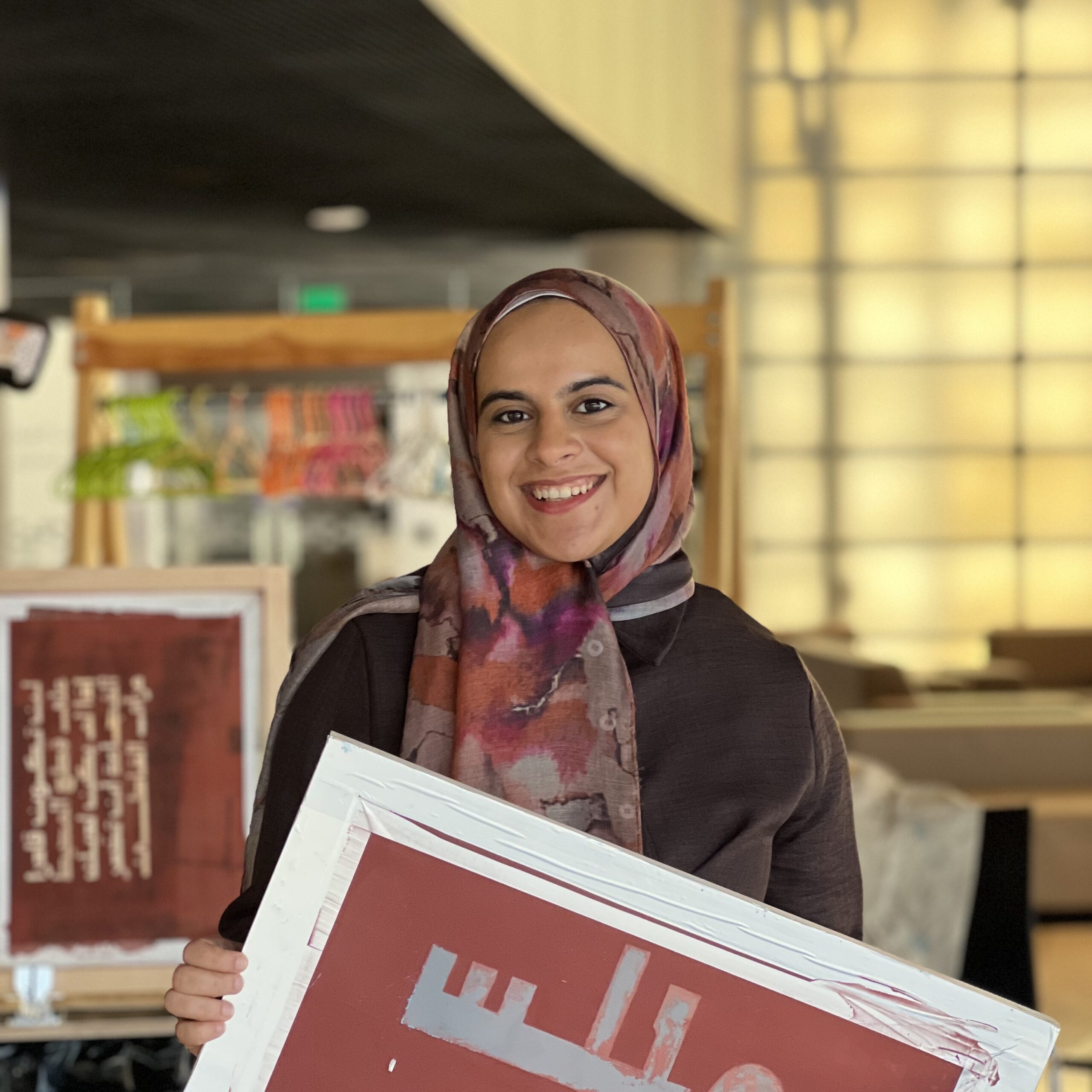
Salma Awad
Salma is a painter and printmaker based in Qatar, whose artistic practice is deeply inspired by her passion for travel and self-discovery. Her work explores the intimate connection between nature, the earth, and emotional well-being, highlighting how grounding oneself in the natural world can restore balance and guide individuals back to their authentic selves. Through her art, Salma recreates vivid, transformative moments she has experienced in nature, harnessing their therapeutic power to reconnect with those memories and emotions. She earned a Bachelor of Fine Arts degree in Painting & Printmaking, with a minor in Art History, from VCUarts Qatar. Beyond her studio practice, Salma worked as an Admissions Counselor at VCUarts Qatar, where she guided aspiring artists through portfolio development and inspired them to pursue their creative dreams. Sharing her knowledge and passion, she finds fulfillment in leading community workshops and teaching printmaking techniques. Salma’s work has been featured in exhibitions and she has contributed to significant artistic collaborations, including a landmark public mural project in Qatar. Her art captures the harmony of the natural world, expressing emotion and experience through vibrant colors, bold forms, and expressive brushstrokes. Each piece invites viewers to embark on their own journeys of self-reflection and connection, resonating deeply with the universal quest for balance and authenticity.